Rope Action City Fighting Game
HitBox GamesRole Playing
4.431.00 Reviews
- Version
- 9.5
- Installs
- 10.00M
- Age Rating
- Teen
Screenshots
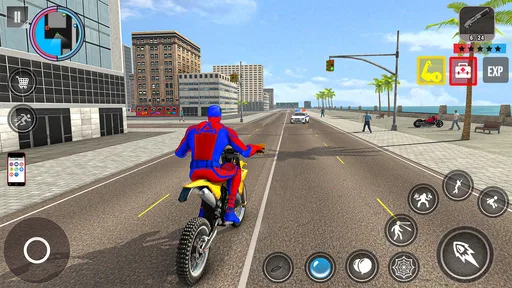
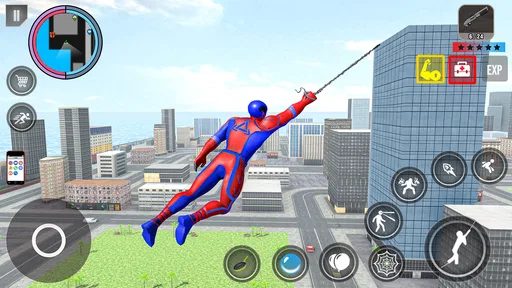
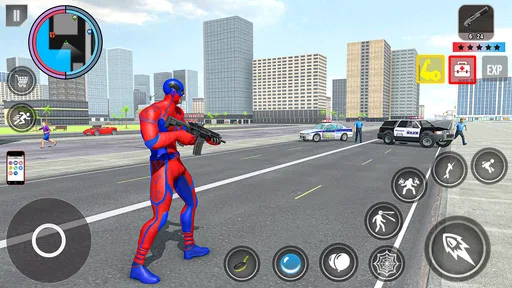
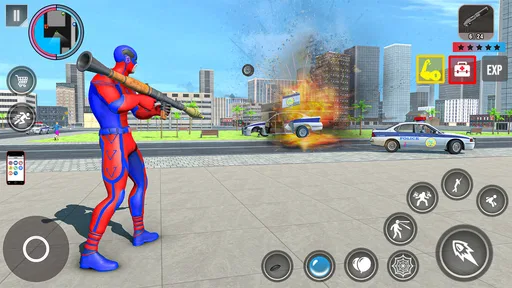
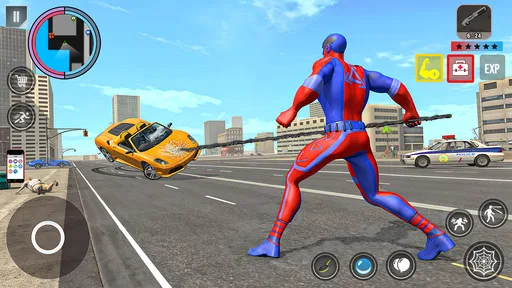
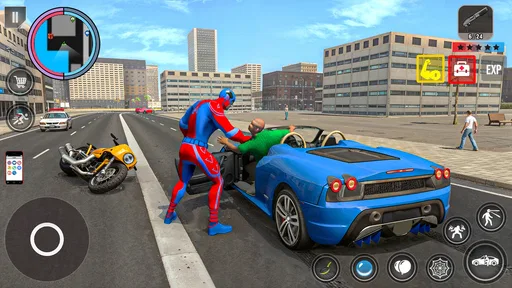
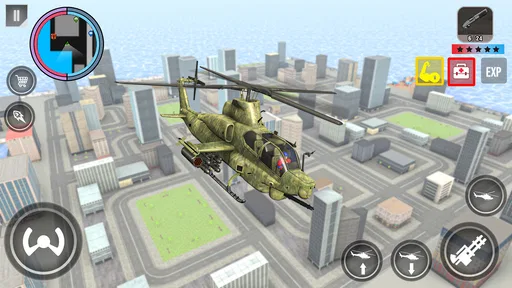
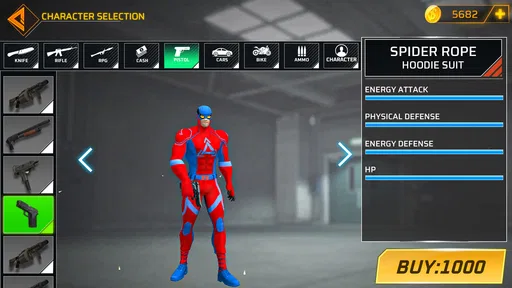
Our Review of Rope Action City Fighting Game
 Analysis by Appyee
Rope Action City Fighting Game takes one clear idea and builds its whole identity around it: moving through a city with rope-based action while fighting and driving vehicles. I found that this focus gives the game a more physical feel than a typical menu-driven role-playing title. Instead of simply walking from one marker to another, I was constantly deciding whether to travel normally, swing toward a target, jump into a vehicle, or stop and deal with an enemy encounter.
That freedom is also the reason I kept coming back to it. The game is free to download, aimed at Teen players, and developed by HitBox Games. It has reached over ten million installs and holds a 4.4 average from around twenty thousand ratings, which suggests that its simple open-world formula has found a sizeable audience. My experience was more mixed in the best possible way: the core movement is immediately entertaining, but the game is most enjoyable when I treated it as a quick action playground rather than expecting the depth of a large console role-playing adventure.
Why the rope movement matters more than the fighting
The rope is not just a decorative superpower attached to ordinary city travel. It changes how I read the environment. A street, building, or open area becomes part of a route, and I start looking for the quickest or most amusing way to reach the next activity. That makes movement itself a small challenge. The pleasure comes from turning a destination into a launch point, rather than following the safest road every time.
This capability also gives the game a useful rhythm. Driving is practical when I want to cover ground, while rope movement is better when I want to cut across the city or approach an area with more control. Fighting then interrupts that travel and gives the journey a reason to continue. The result is a loop of movement, confrontation, and escape that feels more active than a conventional role-playing game built mainly around dialogue and equipment screens.
The most important strength is that travel becomes gameplay instead of empty distance. I noticed this especially when I stopped treating the city as a backdrop. A roof, road, parked vehicle, or open space could become part of my next decision. Even a short session felt more engaging when I set myself a small personal goal, such as reaching a location without staying on the road or switching between rope travel and driving whenever the route allowed it.
Learning the movement without overthinking it
The basic appeal is easy to understand, so I did not need a long adjustment period before having fun. The harder part was using the rope deliberately rather than tapping it whenever I wanted to move faster. A rushed swing can put me in a poor position, while a carefully chosen launch can avoid traffic, shorten a route, or place me closer to an encounter. That difference is small, but it is where the game develops some of its personality.
I recommend spending the first few minutes testing movement in a quiet area instead of immediately chasing every activity. I paid attention to how much space I needed, how the character approached surfaces, and when driving was more convenient. This made later action feel less random. It also helped me avoid a common frustration: repeatedly trying the same movement from an awkward angle when simply repositioning would have been quicker.
The practical tip I found most useful was to think in short hops rather than one perfect swing. Moving from one accessible point to another kept me closer to the ground and gave me more control when I was heading toward a fight. Longer movement looked more dramatic, but shorter adjustments were usually better when I wanted to arrive at a specific place instead of merely crossing the map.
Fighting and driving support the central idea
The combat works best as a reason to use movement, not as a standalone technical fighting system. I enjoyed entering an area quickly, dealing with the immediate threat, and then leaving before the sequence became repetitive. The ability to drive gives the city another layer of choice. Vehicles are useful for direct travel, while rope action lets me break away from the road and approach situations from a less predictable direction.
This combination makes the game feel different from a standard role-playing app where the main decisions happen in turn-based menus or character statistics. It is closer to a lightweight open-world action experience with role-playing framing. Players who enjoy constant physical control will probably understand its appeal quickly. Players who want carefully balanced character builds, complex dialogue, or a deep story may find that the movement is doing most of the heavy lifting.
I also found that changing transportation can refresh a familiar route. If I drove everywhere, the city began to feel like a set of roads between objectives. If I used only the rope, I sometimes sacrificed convenience for style. Alternating between the two made ordinary travel less monotonous. That is a simple habit, but it improves the experience more than rushing through every location with one preferred method.
How it feels during an ordinary play session
Imagine having a short break and wanting something more active than a puzzle but less demanding than a long story game. I would start by entering the city, choose a nearby objective, and use the rope to avoid a slow approach through traffic. After a fight, I might take a vehicle and drive toward another area, then leave the road when I wanted a faster or more entertaining route. That kind of session does not require a large time commitment, and it gives me a clear sense of progress even when I am not planning a lengthy campaign.
The game is particularly suited to players who like experimenting with movement. I spent more time enjoying it when I created my own mini-challenges than when I expected every activity to surprise me. For example, I tried reaching places without taking the most obvious road, entering a confrontation from a different direction, and using a vehicle only after exploring an area on foot. These choices are not formal objectives, but they make the central capability more rewarding.
For younger players within the Teen rating, the action should be considered alongside their preference for fighting-focused games. For adults, the rating is less of a concern, but the same point applies: this is built around superhero-style urban action, not a calm exploration game. I would not choose it for a child looking for a nonviolent city sandbox or for someone who prefers purely strategic role-playing.
Where the open-world format works well
The open-world setting gives the rope room to matter. In a narrow level, swinging or rapid movement would be a short animation between combat areas. Here, it can influence how I approach the whole route. The city also provides a reason to switch between movement styles, because roads and open spaces encourage different choices. Even when the environment is mainly serving the action, it supports the game’s central promise better than a sequence of disconnected arenas would.
Another advantage is immediate accessibility. I did not need to study a large cast, memorize a complicated crafting system, or spend a long time preparing before trying the main action. That makes it a reasonable pick for someone who wants a quick mobile role-playing experience with direct controls. The free entry point helps too, since I can test whether the movement feels comfortable before deciding whether it deserves regular space on my phone.
Still, open-world freedom does not automatically mean a world full of meaningful detail. My enjoyment depended on whether I was actively using the movement system. When I simply travelled from one task to another without experimenting, the city felt more functional than memorable. That is an important distinction: the game gives me room to move, but I have to supply some of the curiosity.
Small habits that improve the experience
Use the rope to change approach angles, not only to move faster. Arriving from above or from the side can make a familiar encounter feel less repetitive.
Keep driving as a practical option. Rope movement is the headline feature, but vehicles can make long stretches less tiring and give the session a useful change of pace.
When movement feels unreliable, reposition first. A short step or a different angle is often more effective than repeatedly forcing the same launch.
Play in short personal scenarios. Reaching a destination creatively or escaping an area quickly gives the open city more purpose than simply following the next marker.
These habits also reveal a trade-off. The game rewards improvisation, but it does not necessarily explain every enjoyable way to use the city. I had to discover some of the fun by testing routes and setting my own goals. Players who prefer explicit instructions may find that freedom less satisfying, while players who like experimenting may see it as the main attraction.
The compromises behind the fast action
The biggest limitation is variety over time. The rope, fighting, and vehicles create a strong first impression, but the formula can become familiar if I expect every activity to introduce a new kind of challenge. The game is at its best in bursts, when I want direct action and movement. It is less convincing as a replacement for a deep role-playing game that offers complex progression, detailed character relationships, or a carefully layered narrative.
I also had to accept that convenience and precision do not always point in the same direction. The fastest route is not always the most controlled route, and the most entertaining movement is not always the most efficient. That tension is part of the fun, but it can also create irritation when I am trying to complete something quickly. If a player dislikes trial and error in movement, the central feature may feel more like an obstacle than a reward.
The free model is approachable, but in-app purchases range from $2.99 to $19.99 per item. I would approach those purchases carefully and first decide whether the basic loop is enjoyable without spending. The game’s strongest appeal comes from movement and immediate action, so I would not buy anything simply because I felt pressured to keep up. A sensible approach is to play naturally for several sessions, identify what actually improves your experience, and then decide whether optional spending is worthwhile.
Performance expectations should also be realistic. The game supports devices running Android 7.0 or later, and the current version is 9.5. That makes it available to a broad range of Android users, but compatibility alone does not guarantee that every phone will feel equally comfortable during fast movement and driving. On a smaller or older device, precise control may matter more than raw visual quality. I would test movement early, because a game built around quick positioning is much less enjoyable if the controls feel cramped.
When another type of game would be better
I would choose a more traditional role-playing game if my priority were building a character through detailed statistics, collecting meaningful equipment, or following a substantial story. I would also choose a dedicated racing game if driving were the main reason I wanted to play, because vehicles here support the city adventure rather than define it. Likewise, a pure fighting game would be a better fit for someone who wants tightly focused combat without travel between encounters.
Rope Action City Fighting Game makes sense when the combination matters more than any single part. Its appeal comes from moving through an urban space, changing transportation, and turning travel into a sequence of small action decisions. Separating those elements weakens the reason to play it. That is why I would recommend it to someone who likes superhero-style movement and casual open-world freedom, but not to a player searching for the deepest example of any one genre.
Who gets the most from this game
The best match is a player who enjoys immediate control, short sessions, and the satisfaction of finding a faster or more dramatic route through a city. If you like testing how a character moves through an environment, the rope gives you something to master beyond simply pressing the attack button. The game also suits people who want a free starting point and are comfortable deciding for themselves how much time and money to invest.
It is less suitable for someone who needs a strong narrative to maintain interest. The movement can carry the first sessions, but players who do not enjoy experimenting may soon see the city as a collection of repeated travel and combat moments. It is also not my first recommendation for anyone who dislikes in-app purchase models or wants a completely uninterrupted premium experience. The free download is useful for trying the game, but expectations about optional spending should be set before committing to it long term.
HitBox Games has made a focused role-playing action game rather than an all-purpose mobile adventure. The focus is valuable: the rope gives travel a physical identity, vehicles add practical variety, and fighting provides immediate reasons to use both. My advice is to judge it by that capability. Do not install it expecting a massive role-playing system; install it if the thought of crossing a city by rope, road, and improvised routes sounds entertaining.
After spending time with it, I see the game as a good casual action choice with a distinctive movement hook. It is free, widely available on compatible Android devices, and easy to sample, but its long-term value depends on how much enjoyment you get from experimenting with the same core tools. For me, the decisive question is simple: do you enjoy making movement part of the challenge? If the answer is yes, this urban adventure can provide lively short sessions. If the answer is no, a story-led role-playing game or a dedicated combat title will probably serve you better.
Verdict
Strengths of Rope Action City Fighting Game
- Simple controls make it easy to swing, jump, and fight.
- Urban levels offer varied routes and platforming opportunities.
- Quick missions suit short gaming sessions.
- Action-focused gameplay keeps combat fast and engaging.
- Offline play is useful when you have no internet connection.
Limitations of Rope Action City Fighting Game
- Repetitive objectives can make longer sessions feel monotonous.
- Enemy behavior is sometimes predictable.
- Progression may feel limited after completing the main stages.
- Touch controls can be imprecise during fast movement.
- Frequent ads may interrupt gameplay, depending on the version.
Similar Picks in This Category
View All
Hair Dye
CrazyLabs LTD4.4

Monster High™ Beauty Salon
CrazyLabs LTD4.5

Bus Simulator - Bus Games 3D
Jima Apps4.4

Flight Pilot: 3D Simulator
Wildlife Studios4.1


Super Stylist Fashion Makeover
CrazyLabs LTD4.4
Frequently Asked Questions
What is Rope Action City Fighting Game?
Rope Action City Fighting Game is an action-packed mobile game that combines superhero-style rope swinging, open-city exploration, and hand-to-hand combat. Players move around an urban environment, complete missions, fight enemies, and use rope-based abilities to travel quickly between buildings. It is designed for casual play, although some missions may become more challenging as opponents grow stronger.
How do you play Rope Action City Fighting Game?
The game generally uses on-screen controls for movement, jumping, attacking, and activating the rope ability. You can explore the city, swing across gaps, chase enemies, and engage in combat during missions. New players should spend a few minutes practicing movement and camera control, because combining rope travel with attacks is important for avoiding damage and completing objectives efficiently.
Can Rope Action City Fighting Game be played offline?
Rope Action City Fighting Game may support offline play for its main action and mission features, but certain elements can depend on the version installed and the developer’s requirements. Advertising, updates, optional rewards, or other online services may still require an internet connection. It is best to launch the game once while connected before playing offline to confirm which features remain available.
Is Rope Action City Fighting Game free to download?
The game is typically offered as a free download, allowing players to install and try its main features without paying upfront. However, free mobile games may include advertisements, optional purchases, or reward-based promotions. Before downloading, check the store listing for the current pricing information, in-app purchase details, supported devices, and any permissions requested by the latest version.
Is Rope Action City Fighting Game suitable for children?
The game may be appealing to younger players because of its simple controls and superhero-inspired action, but it focuses on fighting, chasing, and combat. Parents should review the age rating, advertising policy, and in-app purchase settings before allowing children to play. Using parental controls is recommended, especially if the device is connected to a payment method or shared with other users.
Play our best games!


